






Hyperbaric oxygen at Breathe
Oxygen behaves differently
under pressure.
Under pressure, more oxygen can dissolve in blood plasma and move beyond normal circulation limits. That simple change is where hyperbaric oxygen gets interesting. Here’s what happens next, and what the research says about it.
Book nowHyperbaric packages start at £199, and our membership starts at £349 a month.
See pricingWhat is it? And what does it do for me?
Scroll through the animation to understand hyperbaric oxygen therapy.
One breath, and oxygen crosses into the blood
It has about a quarter of a second in the lungs to do it. Follow it to a single red cell.
Four seats. That is all one red cell has.
Each haemoglobin group takes one oxygen molecule. Four groups, four seats, and the first one makes the next easier to fill.
Breathing ordinary air, those seats are about 97 per cent taken
Which is the part everyone skips. You cannot meaningfully load more oxygen onto a red cell, because there is almost no room left on it.
The cell releases where the body asks
Warmer, harder-working tissue pulls the oxygen off the haemoglobin, and the cell travels on empty, ready to be filled again.
So the extra oxygen goes into the river instead
At pressure, oxygen dissolves directly into the plasma, the fluid your cells are carried in. It needs no seat and no red cell, and it reaches places red cells cannot.
Hyperbaric oxygen at Breathe
A big name for oxygen under pressure.
Hyper means increased. Baric means pressure. Together with concentrated oxygen, that’s the basis of hyperbaric oxygen therapy: raising the pressure so more oxygen can dissolve into your blood.
Hyperbaric packages start at £200, and membership starts at £349 a month.
Scroll to follow the oxygen
01 · Breathe in
Every breath starts here
When you breathe in, oxygen passes from your lungs into your blood. From here, it begins its journey around your body.
02 · It binds
Meet the molecule that carries your oxygen
Inside your red blood cells is a protein called haemoglobin. Each haemoglobin molecule can carry four oxygen molecules, and each red blood cell contains millions of them.
03 · Already full
There’s already very little room left
In a healthy person breathing normal air, haemoglobin leaving the lungs is already close to fully loaded. To carry substantially more oxygen, your blood needs another route.
04 · It lets go
Oxygen gets off where it’s needed
As blood circulates, haemoglobin releases some of its oxygen into surrounding tissues. Harder-working tissues take more, and the blood returns to your lungs to pick up another supply.
05 · Under pressure
Your blood has another way to carry oxygen
Breathing concentrated oxygen under increased pressure allows more oxygen to dissolve directly into plasma, the liquid part of your blood. That extra dissolved oxygen travels with your circulation and can move into surrounding tissues.
What brings you here?
Start with what you want to get back to.
You might be recovering from an injury, living with symptoms that interrupt your day or looking for ways to support an active life. We’ll help you explore whether hyperbaric oxygen has a sensible place in that picture.
Recovery after injury or surgery
Tell us what happened, where you are in your recovery and what your treating team has advised. We’ll look at the relevant evidence and whether the sessions we offer are appropriate alongside your existing care.
Living with an ongoing condition
When symptoms affect your energy, comfort or concentration, understanding your options matters. We’ll discuss the research for your particular condition, including its limitations and how closely it relates to what we offer.
Training and staying active
Whether you compete or simply enjoy moving, you want to know what will actually support your recovery. We’ll talk through your training and goals, and explain what the research can currently tell us.
Taking an interest in your health
You don’t need a dramatic reason to ask questions. If you’re curious about hyperbaric oxygen, we’ll explain how it works and help you decide whether it’s something you want to explore.

Your first visit
You’ll know what’s happening before it happens.

We’ll show you around and sit down to talk through your health history, your questions and what you’re hoping for. We’ll review your suitability before the session and explain anything that needs checking further.
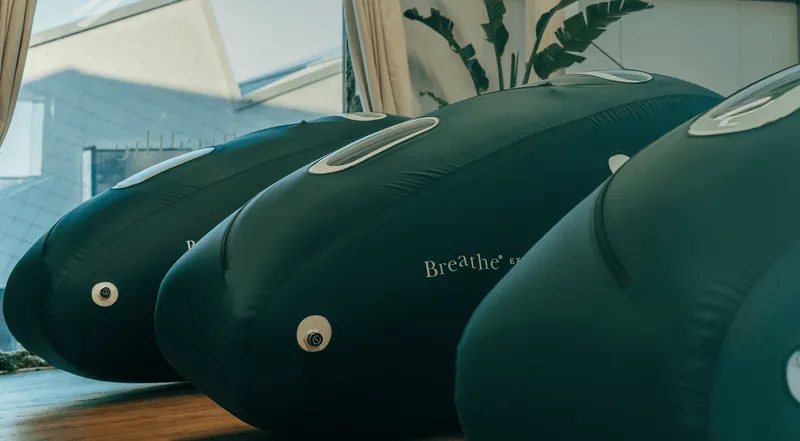
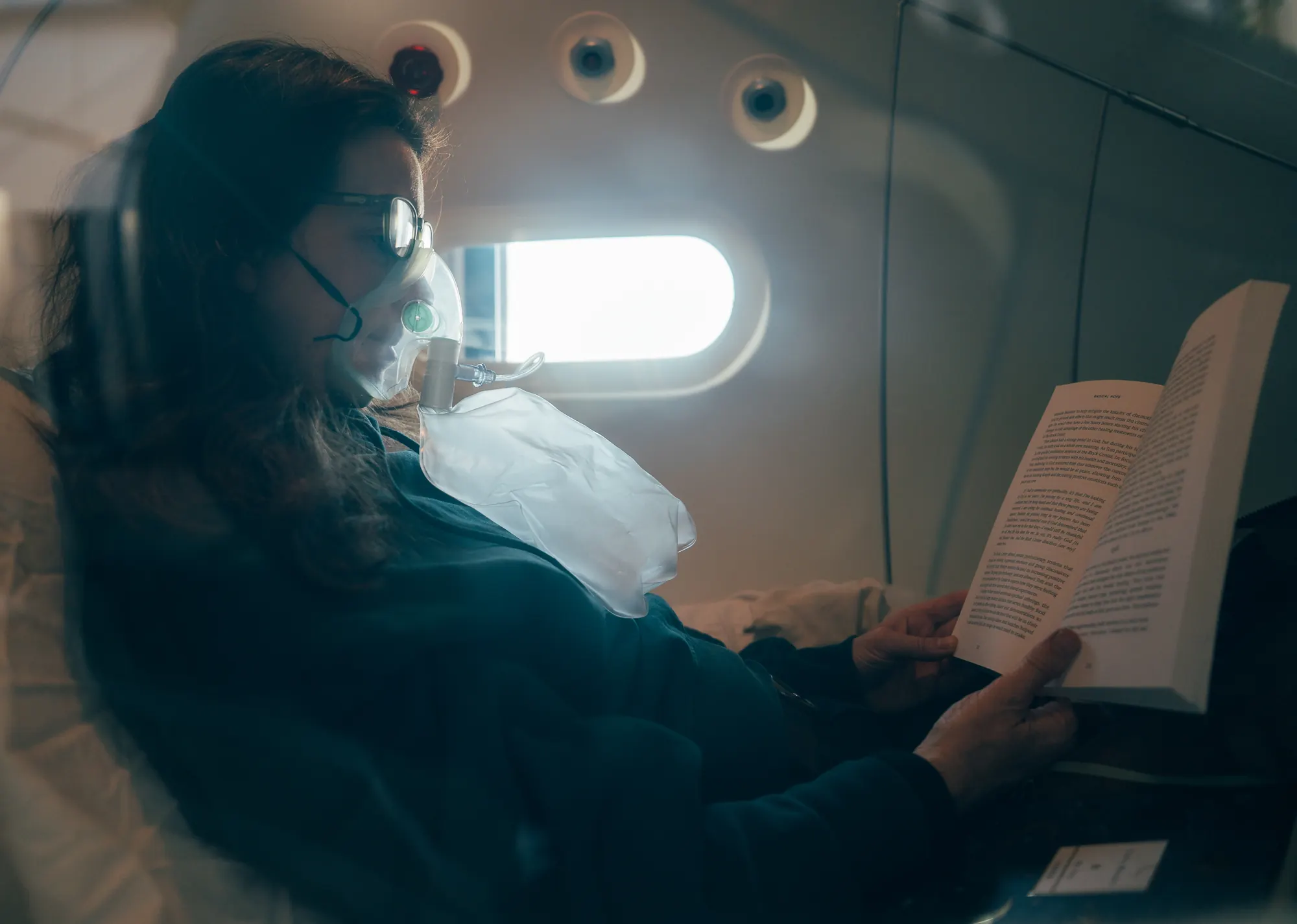
We’ll introduce you to the chamber, fit your oxygen mask and explain how to communicate with us. As the pressure gradually rises, you may feel fullness in your ears, similar to being on a plane. Your practitioner stays beside you and helps you equalise comfortably.
You can read, rest or sleep while we monitor your session. You can speak to the team throughout, and we’ll explain how to let us know if you need anything.
We gradually return the chamber to normal pressure and check how you’re feeling. There’s time to talk through the experience and any next steps before you leave.
Free parking is right outside. If you’re nervous or have access needs, tell us before your visit so we can prepare.
The research
There’s a reason we’re this interested.
Hyperbaric oxygen has a long medical history, including established uses such as treating gas embolism. Research also reaches into conditions such as fibromyalgia, where clinical trials have reported encouraging findings.
Understanding who benefited and how they were treated is part of understanding the result. We bring that detail together in our Library, with plain-English summaries and links to the original studies, organised by condition or goal so you can find what matters to you.
Dissolved oxygen at 1.5 ATA
Strong
This is physics rather than medicine. Raising the pressure and the oxygen fraction raises the oxygen physically dissolved in plasma. It is measured routinely, in arterial blood gases and by transcutaneous oximetry, and nobody disputes it. Research at lower pressures is a younger field than the hospital work: seventeen controlled trials in the 1.25 to 1.75 ATA band, three of them double-blind trials at 1.5 ATA whose treated groups separated from a dummy session.
Worth knowing: a mechanism sits one rung below proof, and the gap between those rungs is wider than it looks.
Read the studies in fullDecompression illness
Strong
Hyperbaric oxygen is the definitive treatment for decompression illness, and it is the clearest case in the whole field. It is also hospital emergency medicine, delivered at around 2.8 ATA under a hyperbaric physician. It is here because it is the reason the biology is taken seriously at all.
Worth knowing: Breathe does not treat decompression illness. Anyone who needs it belongs in a hospital unit immediately.
Read the studies in fullThe recognised hospital indications
Strong
The indications manual of the Undersea and Hyperbaric Medical Society recognises fourteen indications, and the society's current online list adds two more. Every one of them is an acute or serious medical condition managed in a hospital hyperbaric unit, usually as an emergency, usually at 2.0 to 3.0 ATA. We do not treat any of them and we do not accept referrals for any of them.
Worth knowing: approval is specific to each indication. It is approved for some things, so it must be fine for mine is a misconception, and a common one.
Read the studies in fullProblem wounds and diabetic foot ulcers
Moderate
A Cochrane review pooled twelve randomised trials and 577 participants and reported improved healing at six weeks when hyperbaric oxygen was added to specialist wound care in a hospital chamber. The benefit was not evident at longer follow-up, and there was no statistically significant difference in major amputation. When tissue oxygen was measured beside chronic ulcers in 130 people, 1.4 ATA reached 161 mmHg against 333 mmHg at 2.0 ATA, and the authors concluded the lower pressure does not reach the levels associated with healing.
Worth knowing: approved in a hospital, at hospital pressures, alongside a podiatry team. A member with a diabetic foot ulcer belongs under specialist wound care.
Read the studies in fullRadiation tissue injury
Moderate
A 2023 Cochrane review of eighteen trials and 1,071 participants reported a pain reduction of about 10.7 points at twelve months in osteoradionecrosis at moderate certainty, and reduced wound breakdown after surgery in irradiated head and neck tissue at low certainty. Two prevention trials were negative: 144 patients given 30 sessions at 2.4 ATA before dental surgery saw osteoradionecrosis in 6.4 per cent against 5.7 per cent of controls, and a trial in 189 women after breast radiotherapy missed its primary pain endpoint.
Worth knowing: a past course of radiotherapy is not a barrier to a session with us. A radiation dose within the last 24 hours is, and that is a timing rule rather than a lifetime bar.
Read the studies in fullLong COVID
Early
One well-conducted sham-controlled trial of 73 people, given 40 daily ninety-minute sessions at 2.0 ATA, reported a significant improvement in global cognition against sham, with secondary gains in energy, sleep, psychiatric symptoms and pain interference. Against that, a sham-controlled trial of 80 people given 10 sessions at 2.4 ATA missed both primary endpoints, and a registry of 232 patients had no control group. Course length is the most likely explanation for the difference, but that is a hypothesis rather than a finding.
Worth knowing: these trials ran at 2.0 ATA and above, in hospital chambers. They are here as context for the field.
Read the studies in fullFibromyalgia
Early
A crossover trial that analysed 48 women, given 40 sessions of 90 minutes at 2.0 ATA, reported large improvements in the Fibromyalgia Impact Questionnaire and in tender point counts; its authors listed a single site, no blinding and self-reported outcomes as limitations. A 2023 meta-analysis of four trials and 163 participants reported improvement in that questionnaire but no significant difference in pain on a visual-analogue scale, and significantly more side effects in the hyperbaric groups, most of them middle ear barotrauma.
Worth knowing: these trials ran at 2.0 ATA and above. The side-effect finding is worth reading before you book anything.
Read the studies in fullSleep and feeling refreshed
Early
Members often tell us they sleep well the night after a session. That is what they report, and it is not something the session is shown to do. In the research, better sleep appears only as a secondary finding: in two small 1.5 ATA trials in people with persistent symptoms after a head injury, and in a long COVID trial of 40 sessions at 2.0 ATA. It has not been confirmed as a primary endpoint.
Worth knowing: we will keep telling you what members say. We will not turn it into a statement about what the chamber does.
Read the studies in full
Safety & standards
Knowing the equipment is only part of looking after you.
Your health history, the equipment and the way each session is run all matter. Our hyperbaric practitioners are trained and certified through the International Board of Undersea Medicine, and your session is monitored throughout.
Before you begin, we review your health questionnaire, explain the relevant risks and check whether anything needs further assessment. We’ll also explain the clothing, personal-product and equipment rules for your chamber.

Who can come?
Tap to readWho can come?
We welcome people with a wide range of health histories. Suitability depends on your circumstances, your medication and the support you need during a session.
When we need to check further
Tap to readWhen we need to check further
Tell us about lung, heart, ear or sinus problems, seizures, diabetes, recent surgery, implanted devices, pregnancy and any current or recent cancer treatment, and list all your medication.
We may need written clearance from your treating clinician first.

When a session cannot go ahead
Tap to readWhen a session cannot go ahead
An untreated collapsed lung rules out a session, and other conditions or equipment restrictions may too.
If you have a cold, blocked ears or sinuses, a fever or a change in your health, contact us before travelling.

Understanding the risks
Tap to readUnderstanding the risks
Possible side effects include ear or sinus discomfort and pressure injury, and temporary changes in vision during a course. Less common but serious risks include lung injury and oxygen toxicity. Oxygen also increases fire risk, which is why the chamber’s safety rules must be followed.
We’ll discuss the risks relevant to you before you decide to proceed.
Medical information: Breathe’s hyperbaric service is not a substitute for medical assessment, diagnosis or treatment. Our practitioners’ hyperbaric training does not replace the role of your GP or specialist. Continue prescribed care and discuss any proposed changes with your treating clinician. We do not provide emergency hyperbaric treatment or guarantee a particular outcome.