





All staff are trained and certified by the International Board of Undersea Medicine (IBUM).
Click here to learn more
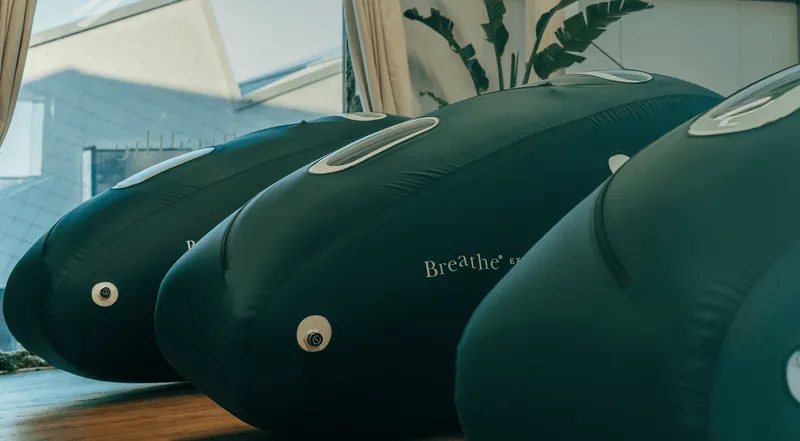
A member sits with Alpha-Stim earclips in place while a Breathe practitioner sets the handheld unit, beside the green hyperbaric chamber

Alpha-Stim at Breathe

A calmer brain
and stable sleep

For members living with anxiety. For veterans who find the switch hard to turn off. For parents running on empty. For anyone simply worn down and after some quiet. Alpha-Stim is a small, regulated medical device that passes a microcurrent, measured in millionths of an amp, between two clips worn on the earlobes. It is drug-free, non-invasive and easy to fit into a visit. You sit back and read, or close your eyes, while it runs.

Talk to us about Alpha-Stim

Alpha-Stim prices are not listed yet — ask us and we will tell you before you book.

See pricing
500 µA
A microcurrent measured in millionths of an amp
20 to 60 min
Session lengths, with time to read or rest
Drug-free
Non-invasive, with no prescription sedatives involved
11 trials
Pooled in a 2022 meta-analysis of around 794 people

Alpha-Stim at Breathe

Alpha-Stim for anxiety and depression in Brighton & Hove

Alpha-Stim is a small device that delivers a gentle electrical current through two clips on your earlobes. Used for anxiety and sleep difficulties, it’s something you can try at Breathe with a practitioner to explain it, set it up and help you decide whether it has a place in your life.

Scroll to see how it works

What’s happening behind the ear clips?

Your brain uses electrical signals to communicate. Alpha-Stim delivers a very low electrical current, and researchers are studying how it influences that activity. The technical name is cranial electrotherapy stimulation, or CES.

01 · Where it starts

Two clips, one on each earlobe

Soft electrodes attach to your earlobes and connect to a small handheld device. We fit them, check you’re comfortable and set the current for your session.

02 · The current

Small enough that you barely feel it

The current is measured in microamps, millionths of an amp. You might notice a light tingling at the clips, or very little at all. Feeling more isn’t the aim.

03 · The network

Your brain stays busy when you stop

Some brain regions work together when your attention turns inward. Known as the default mode network, they’re involved in remembering, imagining and thinking about yourself.

04 · When it runs loud

Sometimes, thinking becomes a loop.

Replaying conversations and circling the same worries can make it difficult to settle. Researchers study how activity within and between brain networks relates to these experiences.

05 · What may change

Activity falls back toward baseline

Alpha-Stim's stated mechanism is normalising signalling in this network, and imaging studies report activity dropping after a session.

500 µAA microcurrent measured in millionths of an amp
20 to 60 minSession lengths, with time to read or rest
Drug-freeNon-invasive, with no prescription sedatives involved
11 trialsPooled in a 2022 meta-analysis of around 794 people

What is it? And what does it do for me?

Scroll through the animation to understand Alpha-Stim.

A human brain seen from above and to the side
Where it starts

Two clips, one on each earlobe

That is the whole apparatus. The current runs between them for the length of a session, and nothing touches the head itself.

The current

Small enough that you barely feel it

Microamps, pulsed slowly, thousands of times weaker than a TENS machine. Most members describe a faint tingle at the earlobe and little else.

The network

The network that runs when you are not busy

Front and back of the midline, and the parietal region either side. It is busiest when attention turns inward, planning, replaying, worrying.

When it runs loud

In anxiety, this network is described as overactive

The nodes stay hot and tightly coupled. On a recording that reads as high amplitude, well above where a settled brain sits.

What may change

Activity falls back toward baseline

Alpha-Stim's stated mechanism is normalising signalling in this network, and imaging studies report activity dropping after a session rather than rising.

What we can say

And where the evidence stops

NICE has reviewed it for anxiety. A sham-controlled trial in NHS primary care found no benefit over placebo for depression. We would rather tell you that than let an animation imply more than it should.

Keep scrolling
↓

Members

What did it feel like for you?

The first session, the unfamiliar ear clips and what happened afterwards. Our members explain their experience of Alpha-Stim in their own words.

←
→

Member video coming soon

Most members feel very little

A mild tingle where the clips sit, or nothing at all, and you set the level yourself.

Member video coming soon

The stillness is part of it

Forty quiet minutes with nothing to do. For some members that is the best part.

Member video coming soon

Give it a few weeks to judge it

Why members give it a few weeks of daily use before they decide.

Member video coming soon

It sits alongside, never instead

How members fit it around their usual care, and keep taking what they are prescribed.

Member video coming soon

Tell us if it does not suit you

A member on what happened when it did not suit them, and why we stopped.

Brain mapping

What researchers measured after a session.

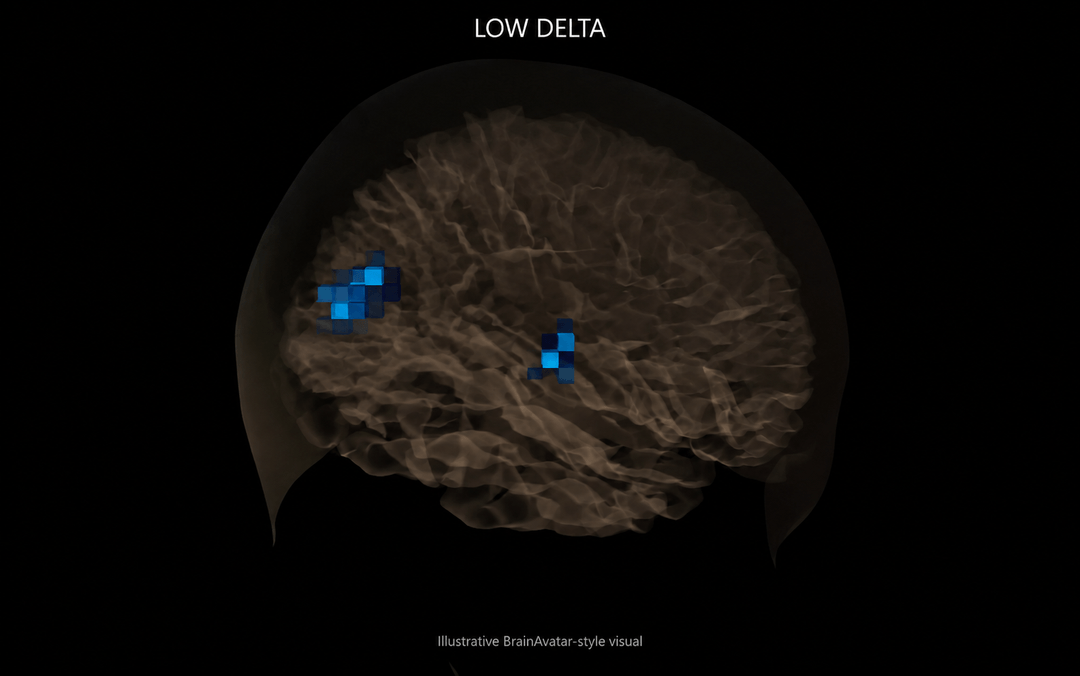
A qEEG brain map measures the electrical rhythms across the head and shows where each one sits against a typical resting range. Delta is the slowest rhythm. It belongs to deep sleep, so when it runs high in a brain that is awake, it is read as a sign of fatigue and a foggy, low-energy state. That is why a fall in delta matters.

Brain map showing high delta activity across the front and centre of the brainBefore a session
Brain map showing only small areas of low delta activityAfter a session
  • Delta and theta came downIn a 2018 study of 50 people at Walter Reed, both slow rhythms dropped 10 minutes after an Alpha-Stim session, while beta rose.
  • Distress scores fellThe same people rated their distress lower after the session.
  • Alpha up, delta downAn earlier qEEG pilot reported more relative alpha and less delta and beta after cranial electrotherapy.

Illustrative brain maps based on the published findings above, not scans of a member.

Your first time

Your first time

We start by understanding what’s brought you here, what you’re finding difficult and any care or medication you already receive. We’ll talk through suitability, explain the device and give you time to ask everything you want to.

Then we’ll fit the ear clips, adjust the settings and help you settle in. Sessions usually last between 20 and 60 minutes, depending on the settings we use. You can read, close your eyes or simply sit comfortably, with our team available throughout.

Afterwards, we’ll talk about how it felt and whether you’d like to explore regular use. There’s no obligation to hire a device or commit to a course.

Free parking, right outside.

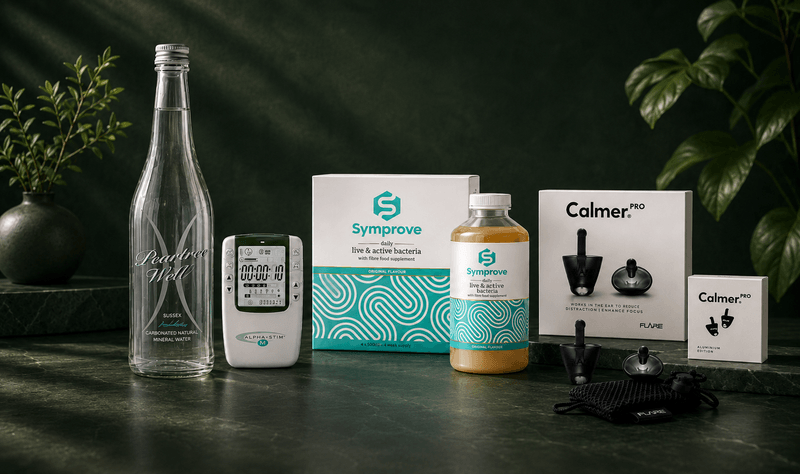
The handheld Alpha-Stim unit, white with a green display, resting against dark leaves

Making it part of your routine

Start with us. Find what fits.

A first session lets you experience Alpha-Stim and get comfortable using it. Research into symptom improvement generally looks at repeated use over several weeks, so we’ll also explain what a regular routine could involve.

Together, we’ll agree what you’re hoping to improve, how you’ll use it and when to review whether it’s helping.

Visit us at Breathe

Have your session here, with someone to set everything up and a place to spend a little time away from the rest of your day. Book Alpha-Stim on its own or speak to us about fitting it around another therapy.

Hire a device

Hiring gives you a way to explore regular use at home before deciding whether to buy. We’ll explain how to use the device, agree your settings and make sure you know how to contact us with questions.

Buy your own

If you’d prefer your own device, we can help you choose between Alpha-Stim AID and Alpha-Stim M. The M includes additional microcurrent functions for pain treatment, so the right choice depends on what you’re looking to address.

Research

What the research has found

If you are here because of anxiety, this is the part that will matter most to you. Alpha-Stim has been studied in randomised trials in the United States, where the FDA has cleared it for anxiety, insomnia and pain. Here is what those studies reported, in plain English, including where the evidence is thin. Pick a topic to read more.

Anxiety

Randomised trial

A randomised, double-blind, sham-controlled trial followed 115 adults with a primary anxiety disorder, using the device for one hour a day over five weeks. It reported a large effect on anxiety, 0.94, alongside 0.78 for depressive symptoms.

Eighty-three per cent of the active group reached a fifty per cent reduction in their anxiety scores over those five weeks, and no adverse events were reported.

Barclay and Barclay, Journal of Affective Disorders 2014, n=115.

Read more in the Library

Anxiety with daily use

Open-label pilot

A pilot study at the University of California, Los Angeles followed 12 adults with generalised anxiety disorder who used Alpha-Stim at home for an hour a day over six weeks. Average anxiety scores fell from 21.3 to 12.7 on the Hamilton Anxiety Rating Scale, a large effect size of 1.52.

Depressive symptoms fell too. This was a small study without a comparison group, and three people stopped early because of headache or dizziness.

Bystritsky, Kerwin and Feusner, Journal of Clinical Psychiatry 2008, n=12.

Read more in the Library

Service members and veterans

User survey

US service members and veterans who had been given Alpha-Stim through the Department of Defense or the Department of Veterans Affairs were surveyed about their experience. Of the 114 who used it for anxiety, 66.7 per cent reported an improvement of at least 25 per cent, and 46.5 per cent reported at least 50 per cent.

Of the 88 who used it for post-traumatic stress, 62.5 per cent reported an improvement of at least 25 per cent. Ninety-nine per cent said they considered it safe to use at home.

Kirsch and colleagues, US Army Medical Department Journal 2014, n=145. These are self-reported results without a comparison group, and the authors have links to the manufacturer.

Read more in the Library

Comfort and side effects

Safety record

This is the most reassuring part of the Alpha-Stim story. No serious side effects have been reported in randomised trials, and where side effects are reported they are mild and short-lived.

The commonest are headache, dizziness, or irritation where the clips sit. Across the manufacturer's pooled figures for roughly 8,792 people, headache was recorded at 0.10 per cent and dizziness at 0.07 per cent.

US Department of Veterans Affairs evidence review 2018; pooled figures from the Alpha-Stim AID owner's manual, which are the manufacturer's own.

Read more in the Library

Pain

Sham-controlled trials

Fibromyalgia is the most studied pain use. Three sham-controlled trials reported benefit for Alpha-Stim compared with a dummy device, with modest effect sizes.

In the United States the FDA has cleared Alpha-Stim for pain as well as for anxiety and insomnia. The Alpha-Stim M adds a separate microcurrent mode applied directly to a painful area.

US Department of Veterans Affairs evidence review 2018; Lichtbroun and colleagues, Journal of Clinical Rheumatology 2001.

Read more in the Library

Every study above is set out in full, in plain English, in our research Library.

An illustrated library with glowing bookshelves and tall arched windows, where members read in armchairs beneath a luminous red dragon coiling through the hall.

A few good questions

Before you settle in.

Is Alpha-Stim a regulated medical device?

Yes. Alpha-Stim AID and Alpha-Stim M are CE-marked Class IIa medical devices. They have been independently tested against applicable medical equipment safety and electromagnetic compatibility standards.

In the United States, Alpha-Stim’s CES technology is FDA-cleared for anxiety and insomnia. Alpha-Stim M also has clearance for its additional pain-treatment technology. Depression is an indication outside the US, but is not FDA-cleared. The country, model and intended use matter when describing its regulatory status.

Has Alpha-Stim been used in the NHS?

Yes. Alpha-Stim has been studied and used within NHS services, including with people experiencing anxiety. NICE has assessed Alpha-Stim AID for anxiety disorders and identified a need for further research. Use within an NHS service is different from a recommendation for routine use across the NHS.

What does the research say?

There are controlled trials, clinical service evaluations and studies looking at how CES influences brain activity. Some anxiety studies have reported meaningful improvements with regular use.

The findings vary by condition. For example, a larger UK trial in people with major depression found that active Alpha-Stim did not outperform a sham device. Our Library separates these areas so you can explore the research relevant to you, with summaries and links to the original papers.

What does a session actually feel like?

You might feel a gentle tingling where the clips touch your earlobes, or barely notice the current at all. We adjust the settings to keep you comfortable. A stronger sensation isn’t the goal.

You can sit, read or close your eyes. If anything feels uncomfortable, tell us so we can adjust or stop the session.

What happens at my first appointment?

We’ll talk about what’s brought you here, your health and any medication or care you already receive. Then we’ll explain Alpha-Stim, answer your questions and check that it’s suitable.

We’ll fit the ear clips, set the current and stay with you while you get comfortable. Afterwards, we’ll talk through how it felt and your options for continuing. You don’t have to decide on a course or buy a device that day.

How long does a session last?

Usually 20–60 minutes, depending on the settings and the routine we agree with you. Your first appointment also includes the consultation, so allow extra time. We’ll confirm the appointment length when you book.

How many sessions would I need?

Your first session introduces you to the experience. Studies looking at changes in symptoms commonly involve regular, often daily, use over several weeks.

We’ll explain the schedule we suggest, why we’re suggesting it and when to review it. If frequent use makes sense for you, hiring a device can make that easier to fit around everyday life.

How soon might I notice a difference?

Some people report feeling calmer during or shortly after a session. Others notice changes more gradually, and some don’t find it helpful.

We’ll agree what you’re hoping to improve and how to keep track of it, whether that’s sleep, anxiety symptoms or day-to-day functioning. That gives us something useful to review together.

Can I use it alongside medication or talking therapy?

Alpha-Stim can be used alongside other care where appropriate. Tell us about your medication and treatment during your consultation so we can check suitability and identify anything that needs input from your clinician.

Continue prescribed medication unless your prescriber advises otherwise. Any changes to medication belong with them.

Who can’t use Alpha-Stim at Breathe?

We offer Alpha-Stim to adults aged 22 and over. We don’t offer it during pregnancy, to people with pacemakers, implanted or wearable defibrillators, or other implanted electronic devices.

Under Breathe’s screening policy, we also don’t offer sessions to people with epilepsy or a history of seizures. Our booking questions cover suitability in more detail, and we’ll contact you if anything needs clarification.

Are there any side effects?

Possible side effects include dizziness, headache and skin irritation around the ear clips. Let us know straight away if you feel uncomfortable or unwell.

We’ll explain safe use before you begin, including what to do if symptoms occur during home use.

Can I drive afterwards?

Don’t drive during treatment. Afterwards, make sure you feel fully alert and steady before driving. If you feel dizzy or drowsy, wait until those effects have passed. The manufacturer notes that some people may need to avoid driving or operating machinery for several hours after treatment.

Can I use Alpha-Stim during Red Light Therapy?

Yes, once you’ve completed a separate Alpha-Stim consultation and we’ve confirmed suitability. We can then fit the ear clips and arrange for you to use it during your red light session.

The light exposure lasts 10–15 minutes, while Alpha-Stim may run for longer. Tell us when booking so we can organise the timings.

Can I use it inside the hyperbaric chamber?

No. Alpha-Stim is not used inside our hyperbaric chambers. You can book it before or after a hyperbaric session, subject to suitability, and we’ll help arrange your visit.

What’s the difference between Alpha-Stim AID and Alpha-Stim M?

Both deliver cranial electrotherapy stimulation through ear clips. Alpha-Stim AID focuses on this form of treatment.

Alpha-Stim M also includes probes and body electrodes for additional microcurrent pain treatment. We’ll help you understand which model fits what you’re looking to address and how to use its features properly.

Do I have to buy a device?

No. You can have sessions at Breathe, hire a device for home use or buy your own. We’ll explain the options and current prices before you decide.

If you’re hiring or buying through us, we’ll show you how to use the device and make sure you know how to contact us with questions.

Can I speak to someone before booking?

Of course. Call or WhatsApp us, or arrange a consultation and a look around. We’ll show you the device, explain the options and answer your questions. Parking is free and right outside.